
To quote John Green, "There's only a few things in this world that turn me into a Giant Squid of Anger."
Alyssa Durbin recently wrote about our class discussion of television and how it affected politics, social issues, etc. Her response was obviously well thought-out, and she hit many good points in her resummarization of the discussion. However, there was one part of her response that made me a little upset, and I would like to address it.
"I think it was interesting to learn about how TV caused social issues to become important and relevant. Before television, gay people did not publicize their stand on relationships. However, when people began to be gay on television, it became okay and accepted, although still critiqued. People could be more open with their feelings after seeing something being done by someone famous."
Alyssa says from the start of this paragraph that television makes social issues "become important and relevant." She then goes to list the "social issue" of homosexuality. Now, I'm not the Bearer of Mean Refutations here, but come on. The war on the LGBTQIA+ community was already important and relevant before television. Yes, television helped spread awareness, but there's much TV didn't tell people.

 Do you remember learning about World War II? If so, you probably remember that the Nazis punished Jews. But what textbooks don't say and television documentaries don't tell you is that they also captured and punished homosexuals, as well. They were forced to wear pink triangles as a symbol of their "abnormality" and were treated no different than the rest of their prisoners. Gruesome, right? Still irrelevant or unimportant? Never.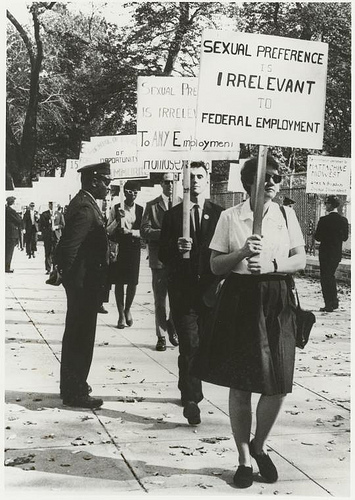
Alyssa, you said that gay people did not publicize their stand on relationships before TV. However, that is simply not the case. The earliest known gay rights organization (the Society for Human Rights in Chicago) was formed in 1924. Television was invented in 1927. While television was still diffusing and becoming a trend, the LGBTQIA+ movement was already well in the making. (A timeline for the major points of the movement is available here.)
Another point I'd like to make is that of your poor phrasing, Alyssa. You said "when people began to be gay on television." How does one "be gay"? Is there a cut-out notion. Must I be flamboyant and burst out singing? Must people kiss the same gender to pass the notion that they are, in fact, not straight? There were gays on television before. People have always been 1) gay and 2) on television. They just didn't publicize it, but you can bet that they WERE, in fact, gay. It is estimated that gay representation in media trickled in slowly around 1980. However, about 25% of the world's population is gay. One-fourth. Wow. So it's almost as if 25% of people starring in TV shows are gay, were gay, etc. Some people were always gay on television, there was not a "when" it started happening.
I agree that people felt more comfortable coming out when they realized that a bunch of celebrities weren't straight; that does ease the feeling of alienation, of course. But that's only logical. As the spread of information about the normalcy of this "social issue" increased, people felt safer to be themselves without fear of rejection or confusion.
Alyssa summed up her response with: "Social issues, such as the gay issue, also were affected by television and people's change of opinion." Again, poor phrasing. "The gay issue," as if it is an issue when, in fact, it is an issue of opinion and bigotry and not the fact that people are gay. Yes, it was affected by television, but more so by the part about "people's change of opinion". You could've expanded on this a lot, I feel, except that doesn't tie in to television that much. More so the internet, but I digress.
So, Alyssa, no offense, but the next time you write about (perceptibly) sensitive things like this, please don't use poor phrasing or say things that are not really true. Swagsexual, outtie.


No comments:
Post a Comment